Introduction
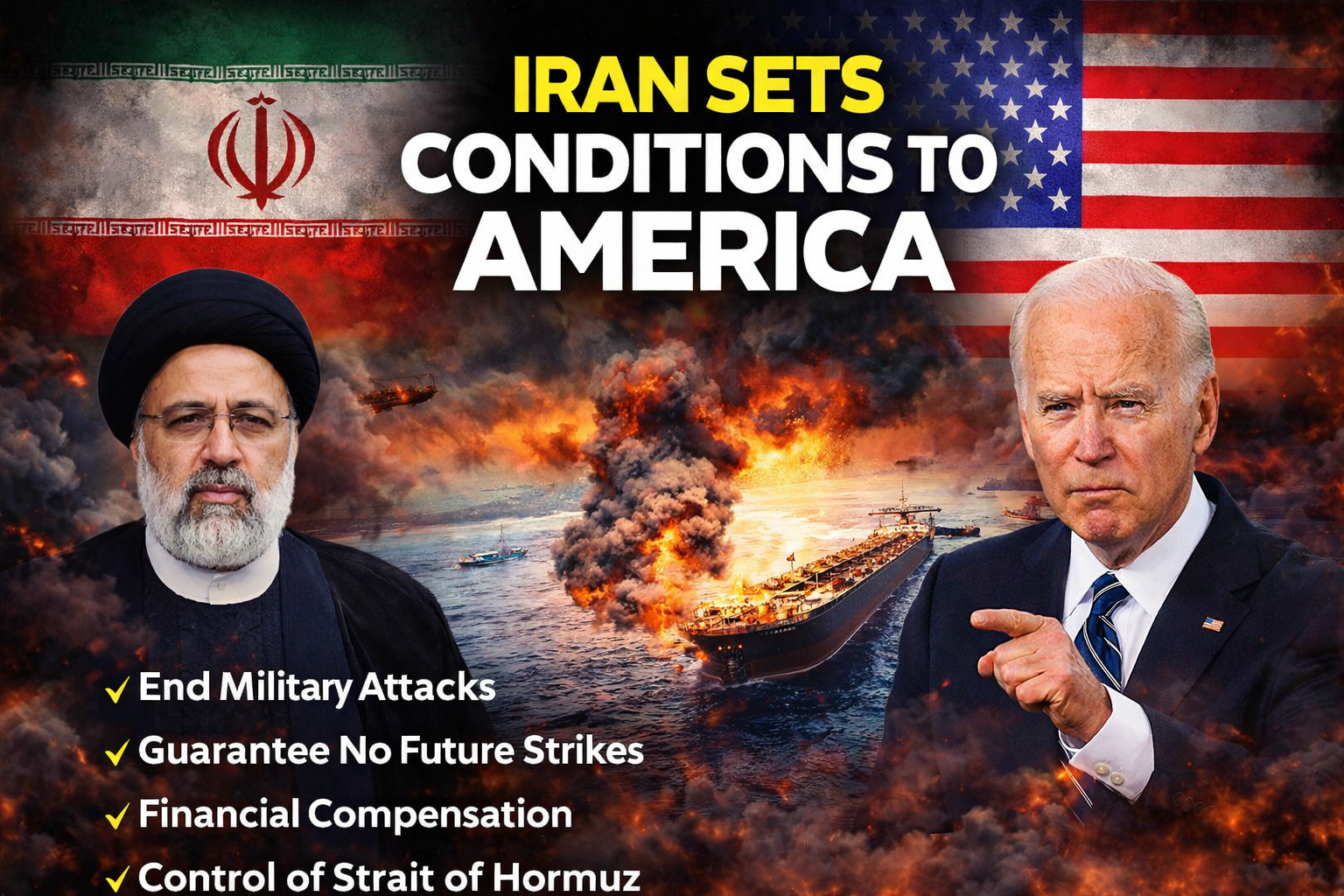
In Iran sets conditions to America The global political landscape has once again been shaken by rising tensions between Iran and the United States. What started as a long-standing geopolitical rivalry has now evolved into a serious situation that is capturing global attention. In recent developments, Iran has made headlines by setting clear and firm conditions for America before agreeing to any peace talks or ending ongoing hostilities. This move has not only intensified diplomatic discussions but has also raised concerns about the future of international stability.
At a time when the world is already dealing with economic uncertainty and regional conflicts, this situation adds another layer of complexity. Governments, analysts, and citizens across the globe are closely monitoring how events unfold, as any major decision between these two powerful nations can have far-reaching consequences.
In this blog, we will take a deep and clear look at the situation where Iran sets conditions to America. We will break down what these conditions actually mean, why Iran has taken such a strong stance, and how the United States is responding. More importantly, we will explore the potential impact of this development on global politics, economic markets, and future diplomatic relations.
The focus keyword “Iran sets conditions to America” is central to understanding this entire geopolitical issue. Throughout this article, you will gain a complete and simplified understanding of the situation without unnecessary complexity, making it easier to grasp even if you are not deeply familiar with international politics.
Background of US-Iran Conflict
Before understanding how Iran sets conditions to America, it is important to know the deep and complex history behind this conflict. The current situation did not happen suddenly—it is the result of decades of political tension, mistrust, and repeated confrontations between the two nations.
The relationship between Iran and the United States was not always hostile. In fact, both countries were once allies before the 1979 Iranian Revolution, which completely changed the political system in Iran and led to strong anti-American policies. This event marked the beginning of long-term tensions and diplomatic breakdown between the two nations.
Since then, the conflict has continued to grow due to several major issues, including:
Nuclear Weapons Development
One of the biggest reasons behind the tension is Iran’s nuclear program. The United States and its allies have long suspected that Iran is trying to develop nuclear weapons, while Iran claims its program is only for peaceful purposes like energy production. This disagreement has led to years of negotiations, agreements, and failures.
A major turning point came in 2015 with the nuclear deal (JCPOA), which aimed to limit Iran’s nuclear activities. However, the deal later collapsed, increasing distrust and pushing both countries toward confrontation again.
In 2026, these tensions escalated into direct conflict involving military strikes, economic disruptions, and global concern.
According to recent reports, both countries entered into a fragile ceasefire, but major disagreements still remain. (Reuters)
Breaking News: Iran Sets Conditions to America
Breaking Development: Iran Sets Conditions to America
The biggest and most significant development in the ongoing conflict is that Iran sets conditions to America before agreeing to any long-term peace negotiations. This is not just a diplomatic move—it represents a major shift in how Iran is positioning itself in global politics.
Instead of accepting pressure or immediate ceasefire proposals, Iran has taken a firm stance by clearly outlining what it expects from the United States. This approach shows that Iran sets conditions to America with a focus on long-term security, sovereignty, and strategic advantage.
According to recent reports, these conditions are not temporary demands but part of a broader framework aimed at shaping a permanent peace agreement.
(Reuters)
These demands clearly show that Iran sets conditions to America from a position of strategic strength.
Key Conditions Iran Has Given to America
As tensions continue to rise, one thing has become very clear—Iran sets conditions to America in a structured and strategic way before agreeing to any meaningful peace process. These conditions are not just political statements; they reflect Iran’s long-term goals related to security, economy, and regional influence.
Let’s take a deeper look at each of these key demands and understand why they matter.
1. Immediate End to Military Strikes
One of the strongest and most urgent demands from Iran is the complete and immediate halt of all US military operations. Iran has made it clear that negotiations cannot begin under the pressure of ongoing attacks.
This condition highlights how Iran sets conditions to America with a strong focus on sovereignty and national security. From Iran’s perspective, continuing military action while discussing peace would make negotiations unfair and one-sided.
In recent years, repeated strikes and counter-strikes have increased mistrust. By demanding an immediate stop, Iran is trying to create a neutral environment where talks can happen without fear or escalation.
2. Guarantee of No Future Attacks
Iran is not interested in short-term solutions. It is demanding clear and reliable guarantees that the United States will not carry out future military attacks after a ceasefire.
This shows that when Iran sets conditions to America, it is thinking beyond temporary peace and focusing on long-term stability. Past agreements have often broken down, leading to renewed conflict, and Iran wants to avoid repeating that cycle.
Such guarantees could involve international monitoring, legal agreements, or involvement of global organizations. This makes the demand more complex but also more meaningful in ensuring lasting peace.
3. Financial Compensation
Another major condition is financial compensation for damages caused during the conflict. Iran claims that its infrastructure, economy, and civilian sectors have suffered significant losses.
This is a powerful diplomatic move because when Iran sets conditions to America, it is not just asking for peace—it is demanding accountability. Compensation could include rebuilding damaged facilities, covering economic losses, or providing financial support.
This demand also increases pressure on the United States, as it introduces an economic dimension to the negotiations. It turns the discussion from purely military into financial and political responsibility.
4. Control Over the Strait of Hormuz
The demand for control over the Strait of Hormuz is perhaps the most strategically important. This narrow waterway is one of the busiest oil transit routes in the world, making it critical for global energy supply.
Iran wants:
- Authority to manage and monitor the strait
- The ability to regulate or restrict ship movement
- The option to charge tolls or fees on passing vessels
This demand is extremely powerful because a large portion of the world’s oil passes through this route. By controlling it, Iran gains significant influence over global markets.
It clearly proves how strategically Iran sets conditions to America, using geography as a key bargaining tool. Even small disruptions in this region can impact oil prices worldwide, making this condition highly sensitive and important.
5. Permanent Peace Agreement
Iran has strongly rejected the idea of temporary ceasefires or short-term arrangements. Instead, it is pushing for a comprehensive and permanent peace agreement that addresses all major issues between the two countries.
This again reinforces the seriousness when Iran sets conditions to America. Iran wants a solution that eliminates the root causes of conflict rather than just pausing it for a short period.
A permanent agreement would likely include:
- Security guarantees
- Economic adjustments
- Political commitments
- Regional stability measures
This approach shows that Iran is aiming for a long-term resolution rather than repeated cycles of conflict.
Why These Conditions Are Important
These conditions are carefully designed and not random. They reflect Iran’s broader strategy to:
- Protect its sovereignty and national security
- Strengthen its position in global negotiations
- Gain economic and strategic advantages
- Ensure long-term peace instead of temporary solutions
The fact that Iran sets conditions to America in such a detailed and firm manner shows a shift in diplomatic dynamics. It indicates that Iran is not just responding to pressure but actively shaping the direction of negotiations.
Conclusion of This Section
In summary, these five key conditions highlight a major turning point in the ongoing conflict. Iran is no longer reacting passively; instead, it is actively shaping the direction of negotiations by clearly defining its expectations. This makes the negotiation process more structured, but at the same time, far more complex and challenging for both sides.
The fact that Iran sets conditions to America before agreeing to peace talks reflects a shift in global diplomatic behavior. It shows that Iran is approaching the situation with long-term planning, focusing not only on ending the current conflict but also on preventing future tensions.
This is exactly why the phrase Iran sets conditions to America has become so important—it represents a new phase in international diplomacy where both nations must carefully evaluate their strategies, compromises, and next steps.
Why Iran Sets Conditions to America
There are several strong and strategic reasons behind Iran’s decision to take such a firm stance. These reasons are deeply connected to its geopolitical position, military capabilities, and internal political messaging.
Strategic Position
Iran holds a highly important geographic position in the Middle East, which gives it a natural advantage in global politics. One of its biggest strengths is its proximity to the Strait of Hormuz, a critical route for global oil transportation.
Because of this, when Iran sets conditions to America, it is leveraging its geographic importance as a powerful negotiation tool. Control or influence over such a key route allows Iran to impact global energy markets, making its demands harder to ignore.
Military Resilience
Despite facing sanctions, pressure, and military actions over the years, Iran has demonstrated strong resilience. Its ability to respond to attacks and maintain its regional influence has strengthened its position.
This is another reason why Iran sets conditions to America with confidence. Iran is signaling that it is capable of defending itself and does not need to accept unfavorable terms under pressure.
Political Messaging
Domestic and international perception also plays a major role. By taking a firm stance and making clear demands, Iran sends a strong message to its citizens and allies that it is not weak or dependent.
When Iran sets conditions to America, it is also shaping its political image—both internally and globally—as a nation that stands firm against external pressure. This helps maintain national unity and strengthens its leadership’s credibility.
America’s Response
While Iran has presented its conditions, the United States also has its own expectations and demands. This has created a complex negotiation environment where both sides are firm in their positions.
The United States is primarily focused on:
- Limiting Iran’s nuclear program
- Stopping or restricting missile development
- Reducing Iran’s influence in the Middle East
These demands reflect long-standing US concerns about regional security and global stability.
However, the major challenge is that both countries have conflicting priorities. This is why, even as Iran sets conditions to America, the US continues to push back with its own requirements.
As a result, negotiations remain difficult, with neither side willing to fully compromise. This ongoing clash of expectations is a key reason why the situation remains unresolved.
Impact on Global Economy
The situation where Iran sets conditions to America is not limited to politics—it has a direct and powerful impact on the global economy.
Oil Prices
The Strait of Hormuz is one of the most important oil transit routes in the world. A significant portion of global oil supply passes through this narrow waterway.
Any tension, restriction, or disruption in this region immediately leads to a rise in oil prices. Since Iran sets conditions to America involving this route, global markets react quickly to every development.
Trade Disruption
Beyond oil, global trade is also affected. Many international shipping routes pass through the Middle East, and instability in the region can cause delays, increased shipping costs, and logistical challenges.
When Iran sets conditions to America, uncertainty increases, and businesses across the world feel the impact through higher costs and supply chain disruptions.
Economic Instability
According to global financial experts and institutions like the International Monetary Fund (IMF), prolonged conflict in this region could lead to long-term economic damage.
Rising oil prices, reduced trade efficiency, and investor uncertainty can slow down economic growth worldwide. This shows that when Iran sets conditions to America, the consequences extend far beyond the two countries involved.
Impact on Middle East Stability
The effects of this situation are especially strong in the Middle East, a region already dealing with complex political and military dynamics.
Increased Military Tensions
As both Iran and the United States maintain strong military presence and alliances in the region, tensions naturally rise. Even small incidents can escalate quickly into larger conflicts.
This is why when Iran sets conditions to America, neighboring countries remain on high alert.
Shifting Regional Alliances
Countries in the Middle East are closely watching the situation and adjusting their strategies. Some nations may support Iran, while others align with the United States.
This shifting balance of power creates uncertainty and can reshape regional politics over time.
Risk of Wider War
Perhaps the most serious concern is the possibility of a larger regional conflict. If negotiations fail or tensions escalate further, more countries could become involved.
Even during periods of ceasefire, the situation remains fragile. This is why the moment where Iran sets conditions to America is seen as a critical turning point that could either lead to peace—or further conflict.
Final Insight
Overall, the situation is highly complex and evolving rapidly. From political strategies to economic consequences, every aspect of this conflict is interconnected.
The fact that Iran sets conditions to America is not just a headline—it is a signal of changing global power dynamics, where negotiations are no longer one-sided but driven by strong positions on both sides.
Political Analysis: Who Has the Upper Hand?
This is a complex question.
Iran’s Strengths
- Strategic location
- Control over oil routes
- Strong regional influence
America’s Strengths
- Military power
- Global alliances
- Economic dominance
The fact that Iran sets conditions to America shows that Iran is negotiating from a position of strength.
Future of US-Iran Relations
The future depends on whether both sides can agree.
Possible outcomes:
- Peace Agreement
- Continued Conflict
- Cold War Situation
At present, since Iran sets conditions to America, negotiations remain uncertain.
Public Reaction Worldwide
People across the world are reacting strongly:
- Concern over World War risk
- Fear of economic crisis
- Interest in political developments
The keyword Iran sets conditions to America is trending globally due to this situation.
Expert Opinions
Experts believe:
- Negotiations will be difficult
- Both sides have strong demands
- Compromise is necessary
Many analysts say that when Iran sets conditions to America, it complicates diplomacy but also opens a path for structured negotiations.
Conclusion
The situation where Iran sets conditions to America is one of the most important geopolitical developments of 2026.
Iran’s demands reflect:
- Strategic thinking
- Political strength
- Long-term planning
At the same time, the United States continues to push its own agenda.
The future remains uncertain, but one thing is clear: the world is watching closely as Iran sets conditions to America, shaping global politics, economy, and security.